

Turkey Opposition Party Surges in Polls, Challenging Erdogan
news

Turkey Opposition Party Surges in Polls, Challenging Erdogan

By Editorial Team•Oct 4, 2026 · 4:46 PM•4 min read
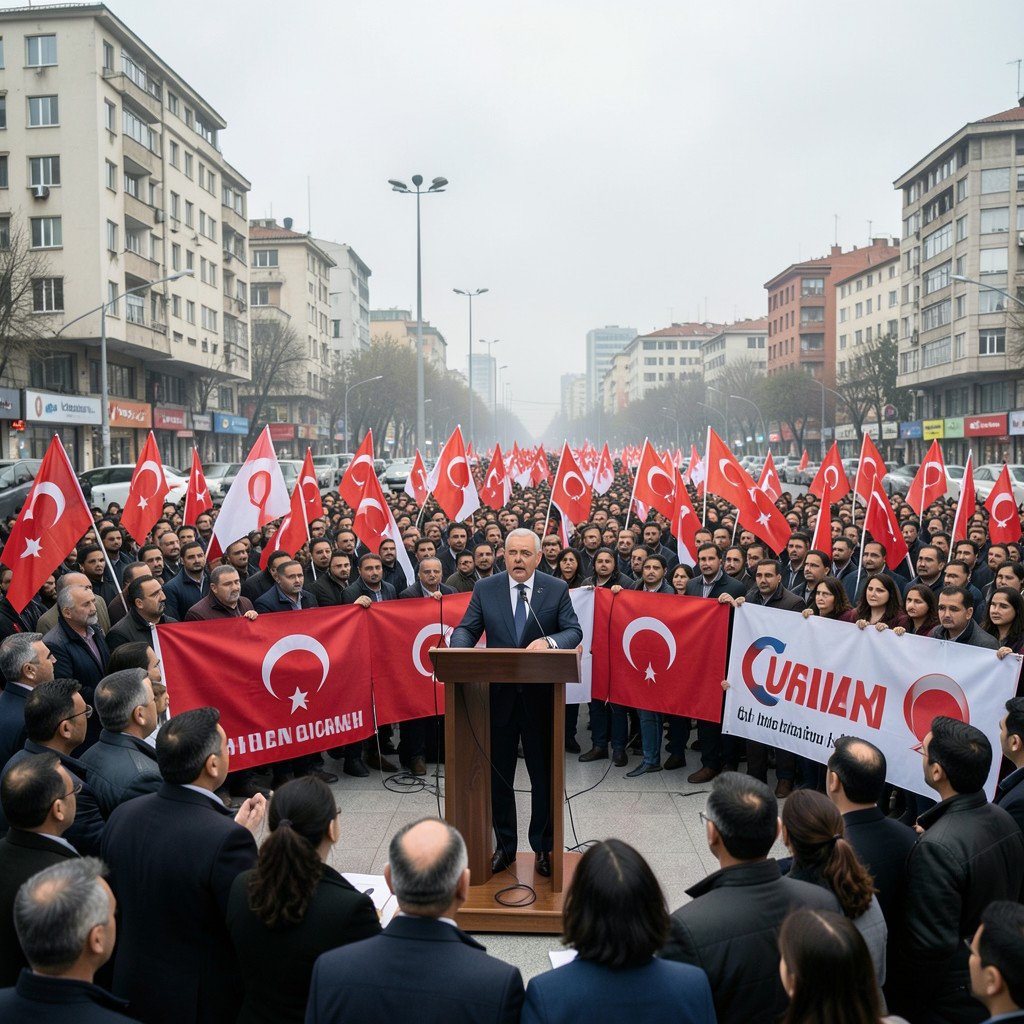
AI-generated representative image: A Turkish opposition political rally, illustrating the rising poll support for a newly formed party challenging the ruling AK
Editorial Team
Editorial Team
Yeni Parti takes second place in September surveys after CHP split, though AK Parti keeps its lead

A newly formed Turkish opposition party has surged to second place in September opinion polls, signaling that President Recep Tayyip Erdogan's main rival has not faded despite a court-ordered leadership change that fractured the Republican People's Party (CHP).

Yeni Parti (New Party), established in late July by former CHP chairman Ozgur Ozel, polled at 23.6% in an ASAL survey and 21.6% in a GENAR survey, trailing the ruling Justice and Development Party (AK Parti) but far ahead of the weakened CHP.

The results matter because they overturn expectations that the opposition split would consolidate Erdogan's dominance ahead of the 2028 elections. Instead, Ozel has retained a substantial share of the opposition electorate and re-established himself as the parliamentary opposition leader.

For Erdogan, the development means his primary rival has relocated rather than disappeared, forcing the ruling bloc to contend with a reinvigorated challenger.

Poll Findings and Party Formation

According to ASAL, 33.8% of respondents would back AK Parti in parliamentary elections, compared with 23.6% for Yeni Parti, a gap of 10.2 percentage points. GENAR placed the ruling party at 36.1% and Ozel's party at 21.6%, a difference of 14.5 points. In both surveys, AK Parti retained the top position while the CHP, now led by Kemal Kilicdaroglu, received only about 6%.

Yeni Parti traces its origins to May, when a court annulled the results of the 2023 CHP congress that had elected Ozel as chairman and reinstated Kilicdaroglu. After weeks of confrontation, Ozel and 90 opposition MPs left the CHP and announced the new party on July 24, immediately securing 91 parliamentary seats to become the largest opposition faction.

Ozel's supporters viewed the court ruling as interference in opposition affairs, while Turkish authorities deny pressuring the judiciary and insist on its independence.

Roots of the Opposition Split

The CHP was founded by Mustafa Kemal Atatürk, the architect of modern Türkiye. The current crisis emerged from a leadership dispute that left the opposition with two headquarters, two leaders, and competing claims over its political legacy.

Unlike a typical splinter movement, Yeni Parti did not start from scratch. Ozel brought with him sitting MPs, prominent politicians, and part of the CHP's organizational network, along with campaign experience from the opposition's victory in the 2024 local elections.

The Turkish opposition also extends beyond Ozel's party. Kilicdaroglu's CHP remains in parliament, alongside the pro-Kurdish DEM Party, the nationalist IYI Party led by Meral Aksener, and other forces with divergent bases and visions. Winning the presidency would require these groups to unite behind a single candidate, a challenge that contributed to the opposition's defeat in 2023.

Voter Migration and Economic Tensions

A July GENAR study placed CHP support at 15.4% and the then-nascent Yeni Parti at 14.5%. By September, the balance had shifted to 21.6% for Ozel's party and 6.6% for the CHP, indicating substantial voter migration between the two forces. Further polls and elections will be needed to confirm whether the opposition's overall electoral base has actually expanded.

The economic climate has added pressure. In September, the Turkish market faced a crisis involving investment funds and a sharp drop in asset prices. Against this backdrop, Yeni Parti representative Zeynel Emre leveled accusations regarding stock market transactions against AK Party Deputy Chairperson Fatma Betul Sayan Kaya and her husband. Kaya requested to be relieved of her party duties pending an investigation. The allegations remain unverified.

Yeni Parti also faces a dispute over its name. The Yenilik Partisi (Innovation Party) argued the name is too similar to its own and appealed to the prosecutor's office. The matter reached the Constitutional Court, which on September 29 granted Yeni Parti 30 days to prepare objections. No final decision has been reached.

What Lies Ahead

Presidential and parliamentary elections are scheduled for 2028. Whether Erdogan can participate hinges on the timing of the vote and constitutional regulations; an early election called by parliament would require a majority of 360 out of 600 deputies, which the ruling bloc lacks on its own.

The opposition's presidential candidate remains unresolved. Ozel has reaffirmed support for Istanbul Mayor Ekrem Imamoglu, who is under arrest and faces legal proceedings, including the invalidation of his university degree, a requirement for presidential candidates. Ankara Mayor Mansur Yavas is also mentioned as a potential contender. For now, the surveys confirm Ozel has retained significant support, but they do not yet show whether Yeni Parti can close the gap with AK Parti.

MORE LIKE THIS

Comments (0)

Leave a comment

A verified Gmail account is required to post comments.

No comments yet. Be the first to share your thoughts!