FIFA urged to probe Argentina Falklands banner
sports

FIFA urged to probe Argentina Falklands banner

By Editorial TeamJul 17, 2026 · 6:55 AM4 min read
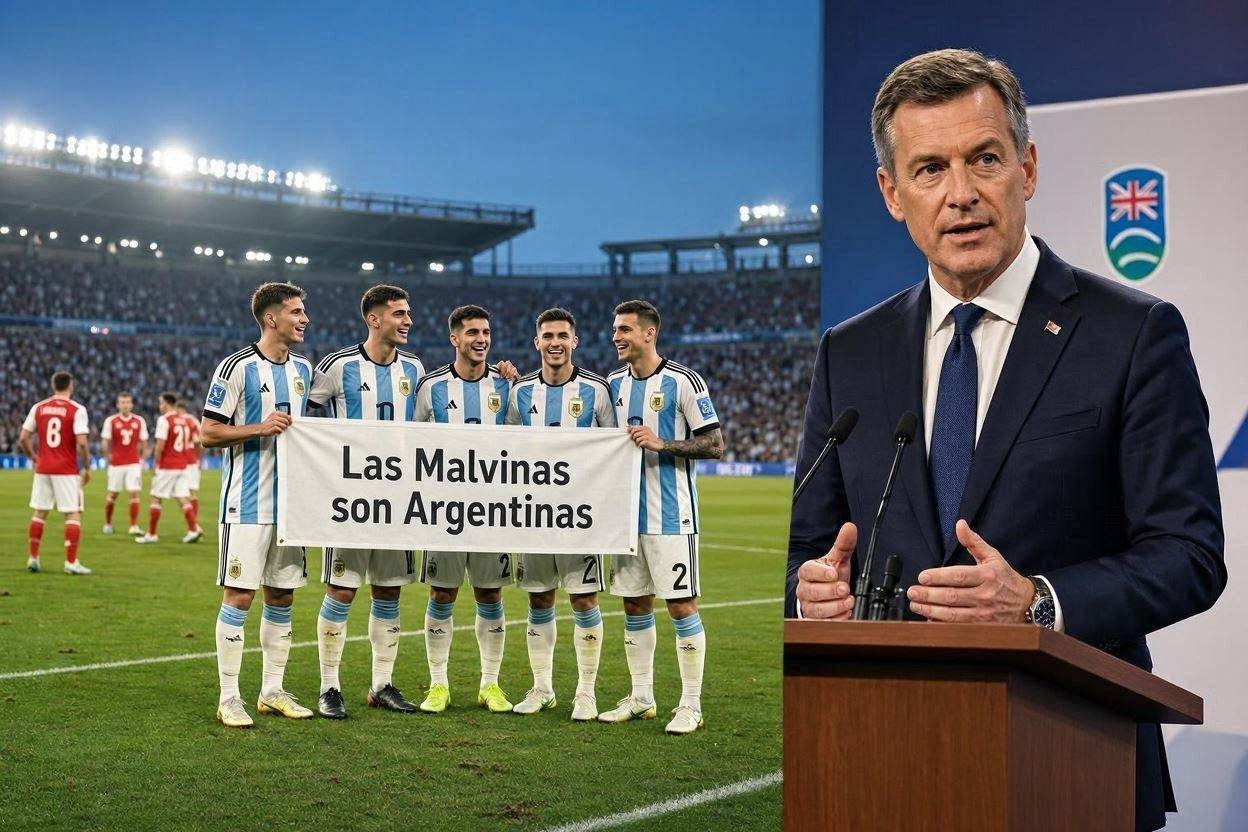
AI-generated representative image. The UK government has urged football’s governing body FIFA to take action after Argentina players displayed a banner asserting Buenos Aires’ claim to the Falkland Islands following England’s World Cup semifinal defeat.
Editorial Team
Editorial Team
UK ministers condemn Malvinas display after England loss

The UK government has urged football’s governing body FIFA to take action after Argentina players displayed a banner asserting Buenos Aires’ claim to the Falkland Islands following England’s World Cup semifinal defeat.

Argentina, the defending champions, beat England 2-1 on Wednesday to reach Sunday’s final against Spain. After the match, Lisandro Martinez and Giovani Lo Celso briefly held up a banner reading “Las Malvinas son Argentinas” (“The Falkland Islands are Argentinian”).

The incident has escalated beyond sport because the Falkland Islands remain a sensitive sovereignty dispute between London and Buenos Aires. UK officials argue the banner amounted to political messaging on the pitch, an area where FIFA rules restrict displays that are political, religious, or personal.

Any decision by FIFA could affect player eligibility and potentially shape how similar incidents are handled at major tournaments.

Calls for FIFA action after banner display

  • Business Secretary Peter Kyle called for “a proper inquiry,” describing the banner as “entirely inappropriate” and an “egregious violation” of FIFA rules.
  • Liberal Democrat leader Ed Davey said the players involved should be barred from Sunday’s World Cup final.
  • Downing Street backed calls for an investigation, with Prime Minister Keir Starmer’s spokesman saying: “The World Cup might not be ours, but the Falkland Islands definitely are,” while noting that disciplinary measures are “a matter for FIFA.”
  • FIFA has not commented publicly on the incident.

Why the Falkland Islands issue remains contentious

The Falkland Islands, a South Atlantic archipelago about 300 miles east of Argentina, have long been disputed by the UK and Argentina. The issue has remained a point of contention since the 74-day Falklands War in 1982, which ended in Argentina’s defeat.

Argentina maintains it inherited the islands after gaining independence from Spain in 1816. The UK considers the territory a British Overseas Territory.

The tournament has seen other disputes linked to political symbolism. Last month, spectators at Iran’s match in Los Angeles displayed Iran’s pre-1979 national flag, a symbol used by opponents of the government in Tehran, despite FIFA’s restrictions on political messaging.

Argentina and England have repeatedly met in high-profile World Cup matches that carried political and cultural weight beyond sport. The rivalry is often traced to the 1966 quarterfinal, the so called “Battle of Wembley,” and was later intensified by the 1986 quarterfinal in Mexico, when Diego Maradona’s “Hand of God” and “Goal of the Century” became enduring reference points. Later tournament meetings in 1998 and 2002 also revived the same charged narratives around the fixture.

Rules and past precedent cited in the dispute

FIFA and the International Football Association Board (IFAB) prohibit political, religious, or personal messages during matches. Sanctions under the rules can include fines and suspensions, as well as sporting penalties such as points deductions and bans.

The banner used by the Argentina players has been the subject of previous disciplinary action. In 2014, Argentina was fined after displaying the same “Las Malvinas son Argentinas” message following a friendly match against Slovenia.

Downing Street, speaking for Prime Minister Keir Starmer, backed calls for FIFA to examine whether the on-pitch display breached tournament rules, while stressing it was for FIFA to decide any action. The Falkland Islands government also condemned the players’ banner, saying it “tarnished” the match with a message unrelated to the game.

Coverage noted a FIFA review would typically assess whether the banner violated event protocols on political items, who brought or authorized it, and whether stadium security failed to prevent a prohibited item from entering. Comparable outcomes in similar disciplinary cases often involve fines or formal warnings, unless aggravating factors are found.

What happens next

No FIFA disciplinary decision has been announced, and the governing body has not issued a public statement addressing the incident. UK officials have called for an investigation, but any sanctions, if imposed, would depend on FIFA’s assessment under its rules on prohibited messaging.

Further clarity is expected only if FIFA confirms whether it is opening a formal inquiry and what measures, if any, will follow ahead of Sunday’s final.

MORE LIKE THIS

Comments (0)

Leave a comment

A verified Gmail account is required to post comments.

No comments yet. Be the first to share your thoughts!