

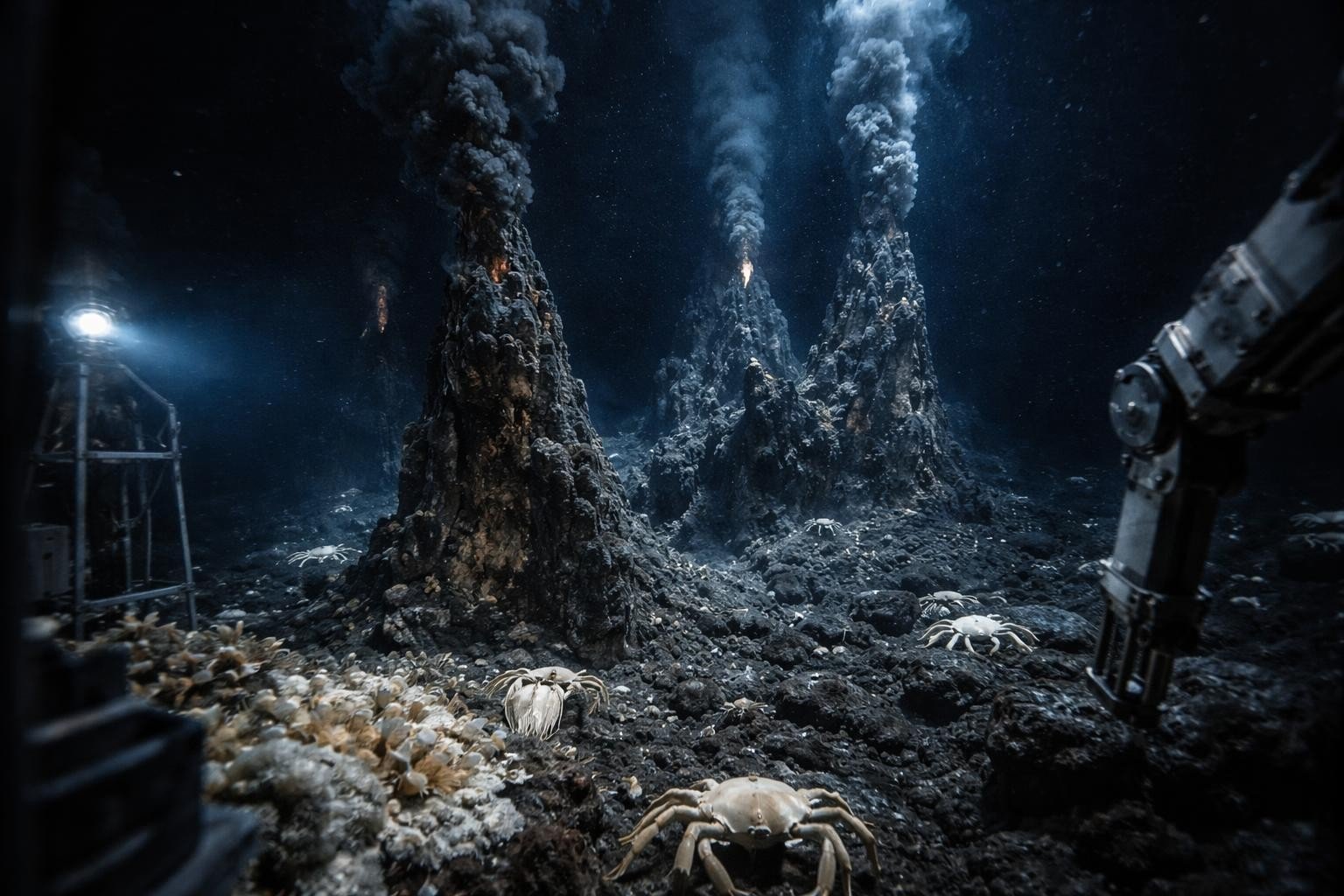
Record Scale: The field contains at least 14 active mineral chimneys, including one towering 60 meters high—making it one of the tallest black smokers ever recorded.
New Ecosystems: Preliminary robotic biological sampling captured unique pale crabs, blind shrimp, and complex bacterial mats that do not match any known genetic sequences.
Geological Surprise: The vents are located in an area previously categorized by marine geologists as seismically dormant for the last 2 million years.
science-and-technology
Maritime Scientists Discover Massive Deep-Sea Hydrothermal Vent System in Southern Ocean
By Editorial Team•Jun 27, 2026 · 9:13 AM•2 min read

Editorial Team
WELLINGTON — An international oceanographic expedition operating off the coast of Antarctica has mapped a massive, previously unknown field of deep-sea hydrothermal vents. Located nearly 3,500 meters beneath the surface of the Southern Ocean, the vent system spans an area of roughly two square kilometers and is venting mineral-rich water at temperatures exceeding 380°C.
The discovery challenges long-held assumptions about tectonic activity and life sustained without sunlight in sub-Antarctic waters. Because these extreme ecosystems thrive entirely on chemosynthesis rather than photosynthesis, studying the unique organisms surrounding the vents could unlock critical secrets regarding the origins of life on Earth and direct scientists where to look for microbial life on icy moons like Europa or Enceladus.
Deep-sea hydrothermal vents are underwater hot springs formed along tectonic plate boundaries where magma heats seeping seawater. Due to the extreme crushing pressures and absolute darkness of the midnight zone, less than 10% of the world's deep ocean floor has been mapped with high-resolution sonar, leaving vast geological features completely hidden from modern science.
The discovery was made using the autonomous underwater vehicle (AUV) Nautilus-X, which detected unexpected thermal anomalies and localized methane spikes in the water column. Data logs released by the Research Vessel Aura confirmed that the vents are spewing vast quantities of iron sulfide and copper, which precipitate into the ocean and form the towering dark chimneys. Spectroscopic analysis of the surrounding water indicates an ecosystem completely independent of the surface world.
The research vessel is currently heading back to port in New Zealand to hand over biological samples to international laboratories for rapid DNA sequencing. The expedition team has formally petitioned the International Seabed Authority to declare a 500-kilometer radius around the coordinate a protected marine sanctuary to prevent potential deep-sea mining exploration.

science-and-technology
Mosquito bites: Why some people attract more, studies find
Researchers link body odour, CO2 and skin microbes to bite risk

science-and-technology
Sporotrichosis in Brazil: Cat-to-Human Spread Grows
Researchers warn antifungal resistance and urge One Health coordination for earlier diagnosis, veterinary care and public health action.

science-and-technology
PlayStation disc phase-out report points to 2028 shift
Unconfirmed claim fuels debate over digital-only game distribution

science-and-technology
US-UK trade deal and opioid deaths: Report raises fears
Report flags pharmaceutical market access and UK prescribing risks
Comments (0)
Leave a comment
No comments yet. Be the first to share your thoughts!