


How the Universe Expands Faster Than Light Without Breaking Physics
science and technology

How the Universe Expands Faster Than Light Without Breaking Physics

By Editorial TeamJul 26, 2026 · 1:45 PM3 min read
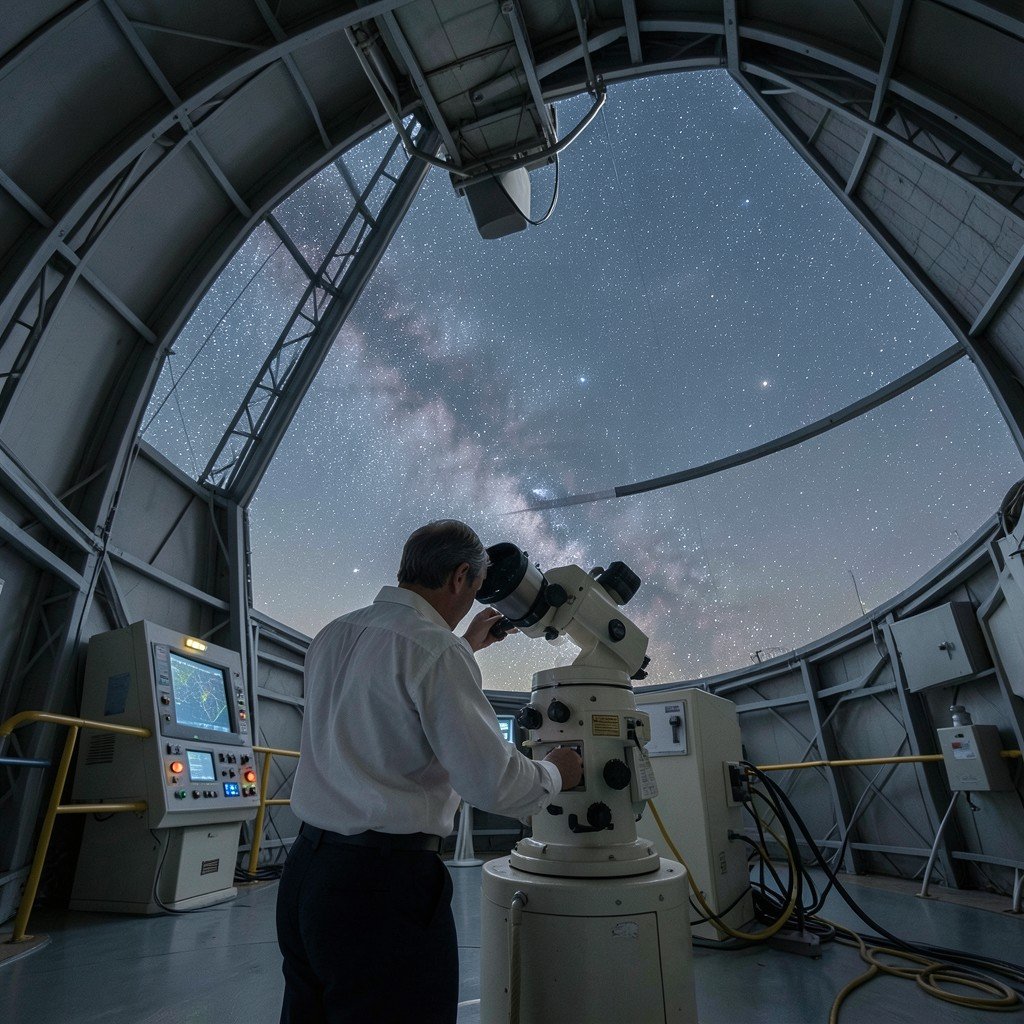
AI-generated representative image. An astronomer works at a research telescope in an observatory, illustrating humanity's study of cosmic expansion and distant
Editorial Team
Editorial Team
Cosmic expansion lets galaxies recede beyond light speed while preserving Einstein's special relativity and redefining the observable universe.

The universe, estimated at 13.77 billion years old, extends to an observable radius of roughly 45 billion light-years, a distance that appears to contradict the cosmic age limit. Astronomers explain this apparent paradox through cosmic expansion, a process in which space itself grows, allowing faraway galaxies to recede faster than the speed of light without violating Einstein's theory of special relativity.

This distinction between motion through space and the expansion of space is fundamental to modern cosmology. It determines how astronomers interpret telescope images, estimate galactic distances, and understand the ultimate limits of what humanity can observe. With dark energy accelerating this expansion, the observable universe is gradually shrinking, raising profound questions about what future civilizations will see in the night sky.

Key Cosmological Discoveries

Astronomers have established several critical milestones in understanding cosmic expansion:

  • The Hubble distance, the threshold at which galaxies begin receding faster than light, is located approximately 13.77 billion light-years away.
  • The cosmological event horizon, the absolute limit beyond which light emitted today will never reach Earth, currently sits about 17 billion light-years away.
  • This event horizon will continue to expand over time but will eventually approach a maximum distance of roughly 60 billion light-years.
  • In approximately 100 billion years, all galaxies beyond the Local Group will fade from view entirely, leaving future observers with a vastly emptier universe.

How Cosmic Expansion Works

Special relativity restricts how fast objects can move through space in a local region. No observer will ever see a nearby rocket passing faster than light. However, cosmic expansion operates differently. Distant galaxies are not necessarily speeding through space; rather, the space between Earth and those galaxies is growing. Special relativity does not place the same restriction on how rapidly large distances can increase across the universe.

Astronomers measure a galaxy's recession speed using redshift, a phenomenon in which light from a receding object is stretched toward redder wavelengths. Edwin Hubble first used this effect to demonstrate that the universe is expanding. In an expanding universe, more distant galaxies recede faster because a greater volume of space lies between them and Earth, providing more distance that can expand.

Observational Evidence and Limits

When a telescope captures light from a distant galaxy, the image reveals the galaxy as it appeared when the light began its journey, not where it is today. To estimate present distances, astronomers rely on cosmological models, primarily the LCDM model, which accounts for dark matter and dark energy.

Galaxies beyond the Hubble distance remain observable because the light reaching Earth today was emitted long ago, when those galaxies were much closer. Some galaxies located even farther away may eventually become visible, provided their light began traveling toward Earth when they were nearer. However, any light emitted now from beyond the cosmological event horizon will never reach Earth, as the expansion of space will prevent it from crossing the growing distance.

The Vanishing Universe

Dark energy continues to accelerate cosmic expansion, making the separation between galaxy clusters increasingly extreme. Even within the cosmological event horizon, light from the most remote galaxies will become stretched to such enormous wavelengths that it will effectively disappear from view. Astronomers anticipate that in about 100 billion years, every galaxy beyond the Local Group will be permanently out of sight, leaving future observers with a universe that appears far smaller and emptier than the one visible today.

MORE LIKE THIS

Comments (0)

Leave a comment

A verified Gmail account is required to post comments.

No comments yet. Be the first to share your thoughts!