


Electron Lighthouse Uses Laser Light to Steer Quantum Current
science-and-technology

Electron Lighthouse Uses Laser Light to Steer Quantum Current

By Editorial TeamJul 28, 2026 · 2:00 PM3 min read
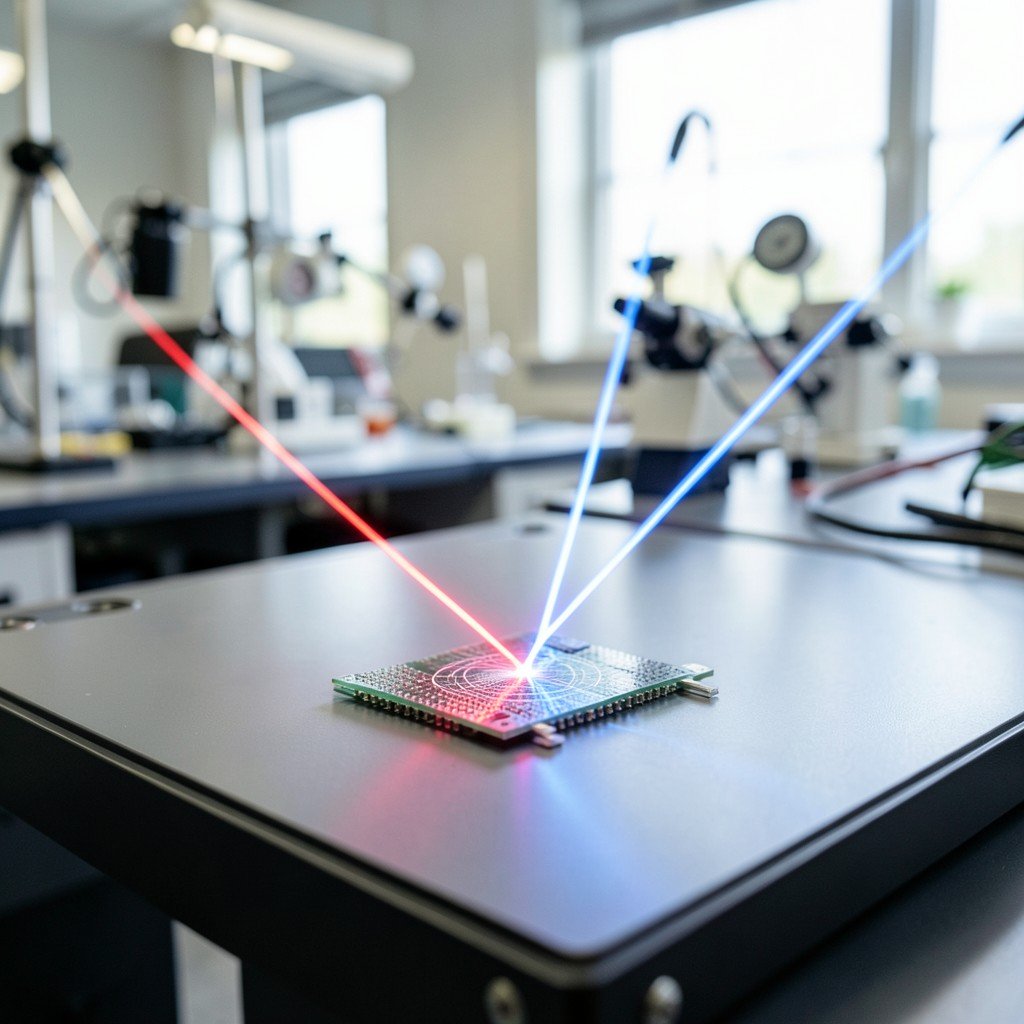
AI-generated representative image. A University of Michigan physics experiment showing two-color laser light steering an electron current through a semiconducto
Editorial Team
Editorial Team
University of Michigan physicists demonstrate first optoelectronic device that directs electron flow with two-color laser interference and no applied electric field.

Physicists at the University of Michigan have built a device that uses two different colors of laser light to generate and precisely steer a narrow stream of electrons through a semiconductor, without applying any external electric field. The breakthrough, reported in Physical Review Letters, represents the first experimental realization of a quantum phenomenon predicted years ago by theorists.

The discovery could eventually support technologies that merge optics and electronics, including advanced sensing, imaging, and telecommunications. It may also lead to better methods of transmitting signals between devices and encoding more information within them, though the researchers emphasize the work originated from fundamental physics rather than an engineering goal.

How the Device Works

The team, supported by the U.S. National Science Foundation, demonstrated that two phase-coherent optical fields with different colors can produce an organized flow of electrons through a semiconductor. By rotating the polarization of those two optical fields, the researchers could change the direction of the resulting current at will.

Senior author Steven Cundiff, a physicist at U-M, explained that the device does something conventional electronics cannot: "Here, using light, you can actually sort of squirt the electrons in a specific direction without applying an electric field." He added, "The light no longer merely switches the current on; it also aims it."

From Theoretical Prediction to Physical Device

The concept of an "electron lighthouse" was originally predicted by J.E. Sipe of the University of Toronto, who had collaborated with the U-M researchers on earlier work. The idea remained theoretical until Yiming Gong, then a doctoral student in the U-M Department of Physics, took on the challenge of fabricating a working device at the university's Lurie Nanofabrication Facility.

Earlier studies had already established that light alone could cause electrons to move through a material. The new experiment advances that finding by producing a narrow, directional stream of electrons whose precise path can be controlled, rather than a diffuse, undirected current.

The Physics Behind the Beam

The effect relies on quantum interference. When the semiconductor absorbs incoming light through two different pathways simultaneously, the two absorption processes can either reinforce or cancel each other out depending on the direction of electron travel. Cundiff likened the phenomenon to overlapping ripples: for electrons moving in one direction, the ripples align and amplify each other; for those traveling in other directions, they cancel out. The result is a current concentrated into a specific direction rather than spreading evenly.

Gong described the fabrication process as painstaking, noting that the biggest challenge was melding the device's materials without introducing any extraneous electric fields. "I worked with the LNF staff to play around with different recipes and temperatures to come up with a manufacturing process," he said. Preventing unwanted fields was essential to confirm that the electron flow came entirely from the light.

What Comes Next

Gong has since earned his doctorate from U-M and now works as a machine learning scientist in Chicago, applying the quantitative skills developed during his physics research. Kai Wang, a former postdoctoral scientist with Cundiff who is now a professor at Sun Yat-Sen University in China, also contributed guidance to the project. While the device was built primarily to explore fundamental physics, its ability to measure different aspects of light suggests potential future applications in optoelectronic technologies.

MORE LIKE THIS

Comments (0)

Leave a comment

A verified Gmail account is required to post comments.

No comments yet. Be the first to share your thoughts!