


Solar Telescope Captures Highest-Resolution Sun Surface Images Ever
science-and-technology

Solar Telescope Captures Highest-Resolution Sun Surface Images Ever

By Editorial TeamAug 6, 2026 · 6:25 PM3 min read
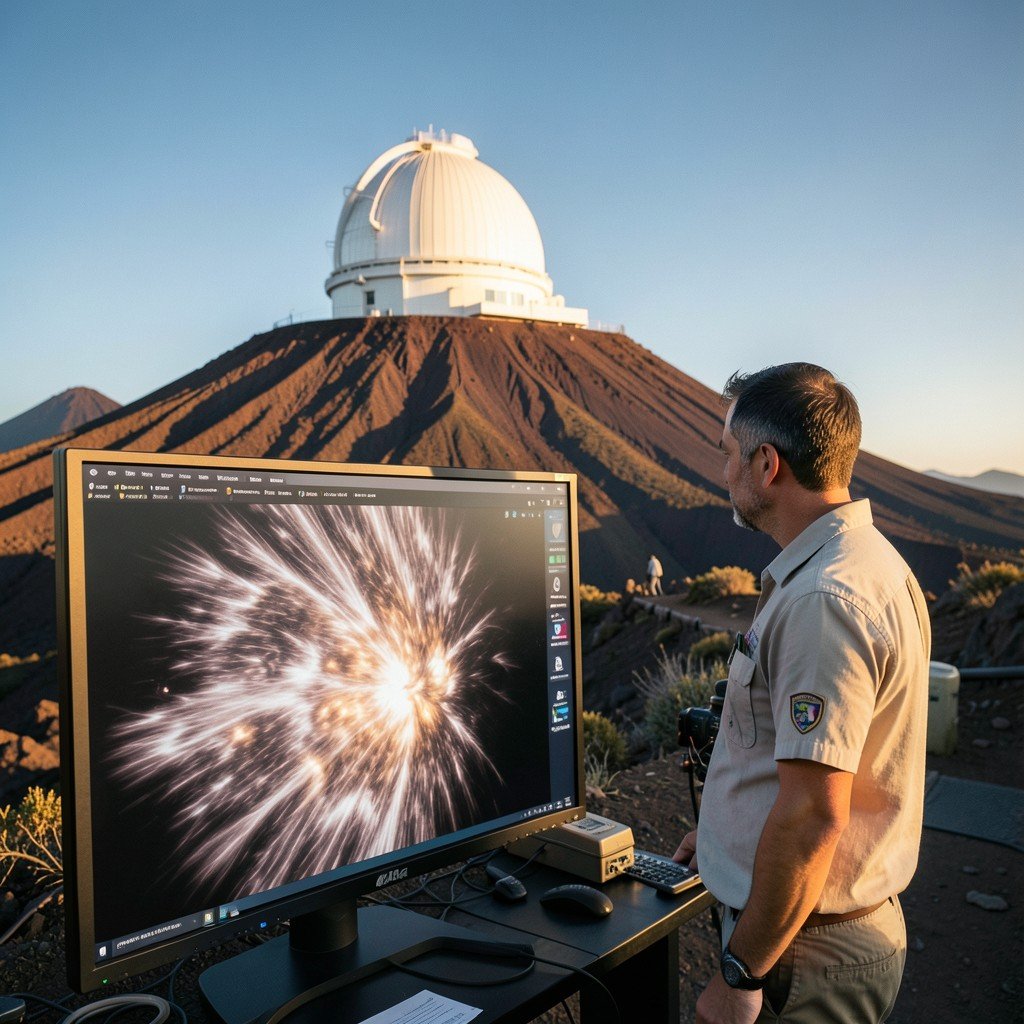
AI-generated representative image: The Daniel K. Inouye Solar Telescope in Hawaii, which captured the highest-resolution images of the sun's surface ever record
Editorial Team
Editorial Team
Hawaii's Daniel K. Inouye Solar Telescope reveals feather-like plasma patterns in unprecedented coronal detail

Researchers using the National Science Foundation's Daniel K. Inouye Solar Telescope in Hawaii have captured the highest-resolution images ever taken of the sun's bright outer shell, revealing strange feathery patterns rippling across the solar surface that scientists compare to the swirling skies of Van Gogh's Starry Night.

The findings, published Wednesday in the journal Nature, mark the first time scientists have observed a well-known fluid instability phenomenon at this level on the solar surface. Understanding these patterns could improve the ability to predict coronal mass ejections, massive solar energy bursts that can disrupt GPS communications and trigger solar storms on Earth.

What the Images Revealed

The photographs, originally taken to test and fine-tune the telescope's capabilities, unexpectedly produced the sharpest view of the sun's outer shell ever recorded. Upon examining the results, researchers identified ripples of instability caused by magnetized plasma moving at different speeds across the surface, a phenomenon similar to waves that form when wind blows over water.

Study co-author Friedrich Wöger of the National Solar Observatory noted that while this fluid dynamics pattern has been observed on Earth, Jupiter, and Saturn, it had never been seen at this resolution on the solar surface before.


The Telescope Behind the Discovery

The Daniel K. Inouye Solar Telescope, situated on the island of Maui, is operated by the National Science Foundation and represents one of the most advanced instruments for solar observation. Scientists had been using the facility to calibrate its imaging systems and push its technical limits when the landmark photographs were captured.

The discovery adds a new dimension to solar physics research, which has long sought to decode the sun's inner workings. Understanding surface-level plasma behavior is considered essential for tracking coronal mass ejections, which can hurl toward Earth and cause geomagnetic disturbances affecting satellites, power grids, and communication networks.

Scientific Reactions

Solar physicist Ruizhu Chen of Stanford University, who was not involved in the research, described the images as reminiscent of famous paintings, specifically comparing the feathery surface patterns to the swirling skies depicted in Vincent van Gogh's Starry Night.

The research team confirmed that the instability patterns result from magnetized plasma fragments sliding past one another at varying velocities. This type of fluid behavior, while theoretically understood, had never been directly imaged on the sun with such clarity until now.

What Comes Next

The findings have been formally published in Nature and are expected to inform ongoing solar observation campaigns. Researchers will likely use the telescope's refined capabilities to continue studying the sun's surface dynamics, with the broader goal of improving early warning systems for solar storms that can affect Earth-based technology and infrastructure.

MORE LIKE THIS

Comments (0)

Leave a comment

A verified Gmail account is required to post comments.

No comments yet. Be the first to share your thoughts!