


Total Solar Eclipse to Darken Europe Skies This Wednesday
news

Total Solar Eclipse to Darken Europe Skies This Wednesday

By Editorial TeamAug 12, 2026 · 12:48 AM4 min read
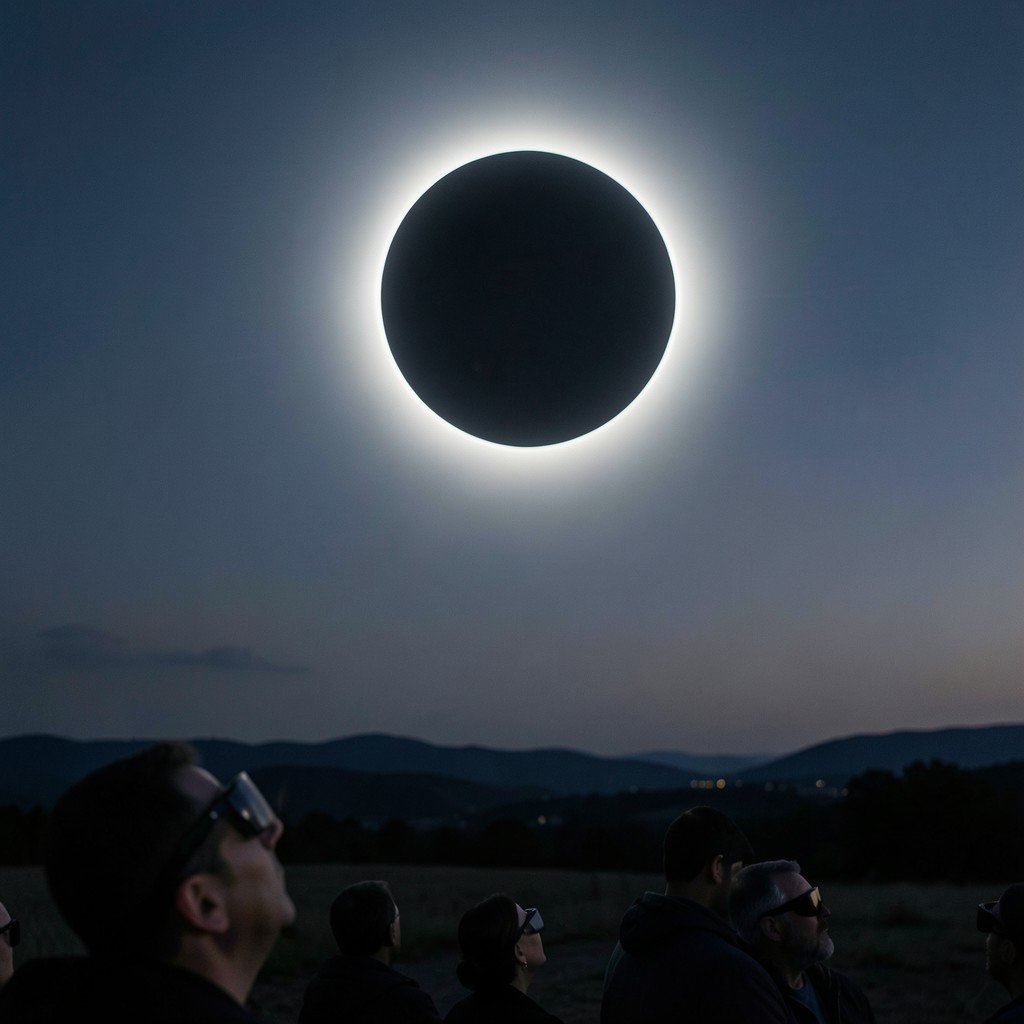
AI-generated representative image. A total solar eclipse darkens the sky as observers wearing protective glasses watch the celestial event.
Editorial Team
Editorial Team
First total solar eclipse visible from Europe in 27 years crosses Greenland, Iceland, Spain and Russia, with NASA tracking the path of totality.

A total solar eclipse will sweep across the Northern Hemisphere on Wednesday, August 12, offering millions of people across Europe their first opportunity to witness the phenomenon in 27 years. The moon's shadow will begin its journey at 15:34 GMT, crossing northern Russia, Greenland and Iceland before reaching Spain and a small portion of Portugal, plunging an estimated 15 million people along the path of totality into near-complete darkness for approximately two minutes.

This rare celestial event marks the first total solar eclipse visible from European soil since 1999. For most of the continent's population, it represents a once-in-a-generation astronomical spectacle. Beyond the path of totality, approximately 980 million people worldwide, roughly one in eight, could witness at least a partial covering of the sun, weather permitting.

Eclipse Timeline and Path

The eclipse will unfold in distinct phases across several hours on Wednesday:

  • 15:34 GMT: Partial eclipse begins at the first location on Earth.
  • 16:58 GMT: Total solar eclipse begins at the first location.
  • 17:46 GMT: Maximum eclipse reached, with totality lasting approximately 2 minutes and 18 seconds near the center of the path.
  • 17:48 GMT (approx): Maximum eclipse reaches Reykjavik, Iceland.
  • 18:27 GMT (approx): Totality reaches Spain, beginning in western regions around 8:27pm local time.
  • 18:34 GMT: Total eclipse phase ends globally.
  • 19:58 GMT: Partial eclipse ends at the last location on Earth.

In Spain, the cities of Leon, Valladolid, Zaragoza, Teruel and Valencia lie directly within the path of totality, with totality lasting up to 110 seconds depending on exact location. Madrid and Barcelona fall just outside this band but will still experience more than 99 percent solar coverage.


Visibility Across Europe and North America

Most of Europe will experience a partial eclipse during the evening hours around sunset. Paris is expected to see roughly 92 percent of the sun covered, while London will observe 91 percent coverage and Berlin approximately 85 percent. For cities farther east, the sun will set before the eclipse reaches its maximum, meaning the deepest phase will not be visible.

In North America, only a partial eclipse will be visible. St. John's, Newfoundland, will see about 53 percent coverage, while Montreal and Toronto will observe 18 percent and 8 percent respectively. In the United States, Fairbanks, Alaska, will experience the deepest eclipse at approximately 37 percent coverage, with Anchorage at 28 percent. Coverage drops significantly elsewhere: Bangor, Maine, at 24 percent, New York at 9 percent, and Detroit at just 3 percent.

Safety Guidelines and Viewing Recommendations

Eye safety remains paramount during the eclipse. Certified eclipse glasses or safe handheld solar viewers must be worn at all times except during the brief period of totality when the moon completely blocks the sun's bright face. Ordinary sunglasses, regardless of how dark, do not provide adequate protection.

Viewers should never look at the sun through cameras, binoculars or telescopes without a specialized solar filter. Eclipse glasses should not be used in combination with unfiltered optical devices, as concentrated sunlight can burn through the filter and cause serious eye damage. For photographers, cameras require a proper solar filter except during the brief minutes of full totality, when the filter can be safely removed. NASA will provide a livestream of the eclipse beginning at 17:15 GMT for those unable to observe directly.

What Comes Next

The next total solar eclipse will occur on August 2, 2027, crossing southern Spain, North Africa, Saudi Arabia and Yemen. For those in the path of Wednesday's eclipse, authorities recommend checking local weather conditions in advance and securing certified viewing equipment ahead of the event. As the moon's shadow races across the planet, millions will look skyward for a brief, unforgettable moment when day turns to night.

MORE LIKE THIS

Comments (0)

Leave a comment

A verified Gmail account is required to post comments.

No comments yet. Be the first to share your thoughts!