NASA CLPS awards $600M for four commercial Moon landers
science-and-technology

NASA CLPS awards $600M for four commercial Moon landers

By Editorial TeamJul 14, 2026 · 9:22 AM6 min read
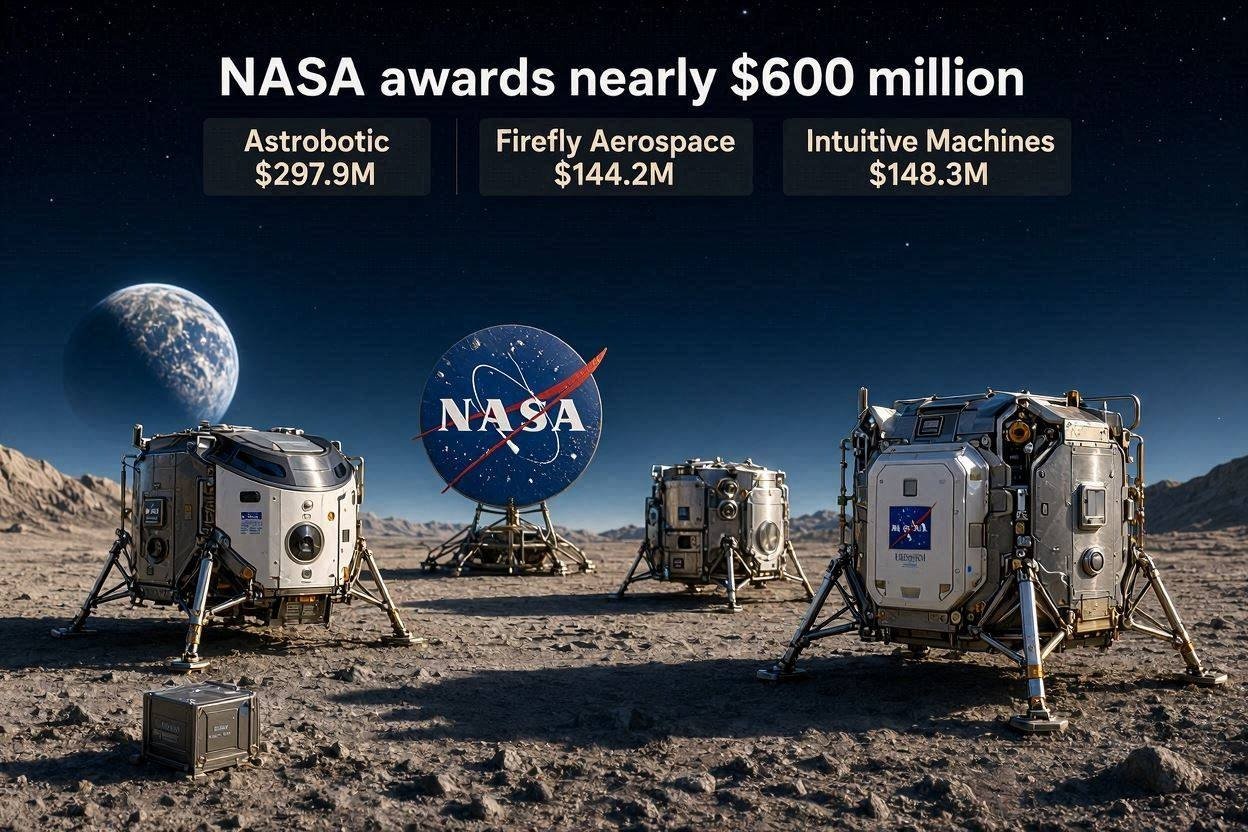
NASA has selected four new commercial Moon missions under its Commercial Lunar Payload Services (CLPS) initiative, awarding nearly $600 million across three companies as the agency accelerates plans for a long-term presence on the lunar surface. Astrobotic received $297.9 million to complete two lunar deliveries, while Firefly Aerospace was awarded $144.2 million for one mission and Intuitive Machines received $148.3 million for one mission. NASA said each flight will use up
Editorial Team
Editorial Team

NASA has selected four new commercial Moon missions under its Commercial Lunar Payload Services (CLPS) initiative, awarding nearly $600 million across three companies as the agency accelerates plans for a long-term presence on the lunar surface.

Astrobotic received $297.9 million to complete two lunar deliveries, while Firefly Aerospace was awarded $144.2 million for one mission and Intuitive Machines received $148.3 million for one mission. NASA said each flight will use upgraded versions of landers that have already been used on previous missions, a strategy intended to increase the pace of lunar exploration.

The new awards underscore NASA’s push to establish what it calls a “Moon Base,” relying on commercial transportation to place scientific instruments and future infrastructure on the lunar surface. By increasing the number of missions and standardizing key measurements across landing sites, NASA aims to build a foundation of environmental and operational data needed for sustained activity on the Moon.

The approach is designed to reduce risk as more spacecraft and heavier equipment begin operating in proximity on the lunar surface, where dust, navigation accuracy, and radiation exposure become major hazards. The same data will also support NASA’s longer-term goal of preparing for future crewed missions to Mars.

NASA said the contracts total almost $600 million and are distributed across three commercial partners for four planned deliveries:

  • Astrobotic: $297.9 million for two lunar deliveries
  • Firefly Aerospace: $144.2 million for one lunar mission
  • Intuitive Machines: $148.3 million for one lunar mission

All four flights will be executed through CLPS, which NASA described as a key transportation system for the Moon Base. The agency said the companies will fly upgraded versions of landers previously used on earlier missions, enabling NASA to increase ordering cadence and launch opportunities.

NASA also said it currently has 17 lunar surface deliveries planned through multiple commercial providers, and that it is considering additional ways for US industry to contribute to Moon Base infrastructure, including more landers and technology demonstrations.

NASA’s CLPS initiative is built around purchasing lunar delivery services from commercial companies, rather than operating all landers directly as government missions. The model is intended to increase launch opportunities and broaden the number of landing locations studied, while helping the agency refine operational practices for sustained work on the Moon.

NASA positioned the latest awards as part of a broader Moon Base effort to establish a long-term human presence on the lunar surface alongside scientific research and commercial activity. In NASA’s framing, the Moon serves as a proving ground for systems, procedures, and environmental understanding needed for longer and more complex exploration missions.

As part of that Moon Base build-out, NASA is weighing a proposal to send PROMISE (Polar Rover for Observation, Mapping, and In-Situ Exploration) to the Moon. NASA described PROMISE as a hybrid engineering development version of the Mars rovers Perseverance and Curiosity, and said it could study both the lunar surface and subsurface while searching for resources that could support future exploration if the proposal is approved.

NASA said it plans to seek proposals for additional lunar landers to transport a power and avionics technology demonstration, another set of scientific instruments, and a South Pole optical imager. The agency also said it will issue an open solicitation for Moon Base technology demonstrations and begin pursuing a lunar communication and navigation relay constellation to strengthen communications between lunar infrastructure and Earth.

The agency described the latest round of missions as part of building a more repeatable, comparable dataset across the Moon by flying standardized payloads on multiple landers. NASA said this approach would help it understand landing hazards and establish a broader network of environmental observations and location markers.


NASA said the new awards are intended to strengthen infrastructure needed for sustained operations on the Moon, and that each company will manage procurement activities, evaluate comparable previous lunar landers, and apply lessons learned to improve mission reliability.

“These new awards to our commercial partners, totaling nearly $600 million to land more missions on the Moon with science payloads, demonstrate our commitment to accelerating our effort to build a long-term presence on the lunar surface, and give us more opportunity to develop the skills we need to prosper there,” said Lori Glaze, associate administrator for the Human Spaceflight Mission Directorate at NASA Headquarters in Washington.

NASA said every mission will carry the same three NASA science payloads so researchers can gather comparable measurements from multiple landing sites:

  • Stereo Camera for Lunar Plume Surface Studies (SCALPSS): four cameras using stereo photogrammetry to create detailed 3D images of how a lander’s engine exhaust disturbs lunar dust during descent. NASA said comparing results across different landers, engine types, propellants, and locations is expected to improve computer models of dust erosion and debris movement as larger spacecraft and heavier equipment land nearer to one another.

  • Laser Retroreflector Array (LRA): a passive navigation device that reflects laser beams from orbiting spacecraft or incoming landers to improve position determination. NASA described each array as about the size of a cookie, containing eight quartz corner cube prisms in a dome-shaped aluminum frame, requiring no electrical power or maintenance and serving as a permanent location marker; similar arrays have flown on previous CLPS missions and international lunar landers, and NASA said it plans to expand the network over time.

  • Linear Energy Transfer Spectrometer (LETS): a radiation monitor designed to measure the Moon’s radiation environment at different landing sites and during various approaches to the surface. NASA said LETS uses proven hardware and a compact silicon detector to measure the energy carried by incoming space radiation, supporting understanding of radiation intensity and types that astronauts may encounter during long-duration missions.

NASA said it is also evaluating whether the landers can carry additional payloads beyond the three standard science instruments.

“We’re building a proving ground for Moon Base operations,” said Ryan Stephan, NASA’s Moon Base acting director of cargo landers. “Accelerating our Moon mission ordering cadence and launch opportunities enable us to move quickly to learn, iterate, and improve.”

“By flying the same science instruments on multiple landers, we will better understand potential hazards during landing and build out a global network of environmental data and location markers on the Moon,” said Joel Kearns, deputy associate administrator for exploration, Science Mission Directorate, NASA Headquarters. “It’s akin to having weather stations in different locations on Earth. These three payloads are flight-proven and their data is critical to supporting safe human exploration of the lunar surface.”

NASA said the awards were announced on June 30 and will be implemented through CLPS, with Astrobotic, Firefly Aerospace, and Intuitive Machines responsible for executing the missions using upgraded lander designs informed by lessons from comparable previous lunar landers. The agency has not specified in the provided material the launch dates, landing dates, or target landing sites for the four missions.

Next steps outlined by NASA include considering the PROMISE rover proposal, seeking proposals for additional landers carrying technology demonstrations and scientific instruments including a South Pole optical imager, issuing an open solicitation for Moon Base technology demonstrations, and pursuing a lunar communication and navigation relay constellation to improve links between the Moon and Earth as lunar infrastructure expands.

MORE LIKE THIS

Comments (0)

Leave a comment

A verified Gmail account is required to post comments.

No comments yet. Be the first to share your thoughts!