


Spain Deploys Military to Ceuta After 34 Die in Migrant Surge
news

Spain Deploys Military to Ceuta After 34 Die in Migrant Surge

By Editorial TeamJul 31, 2026 · 3:48 PM4 min read
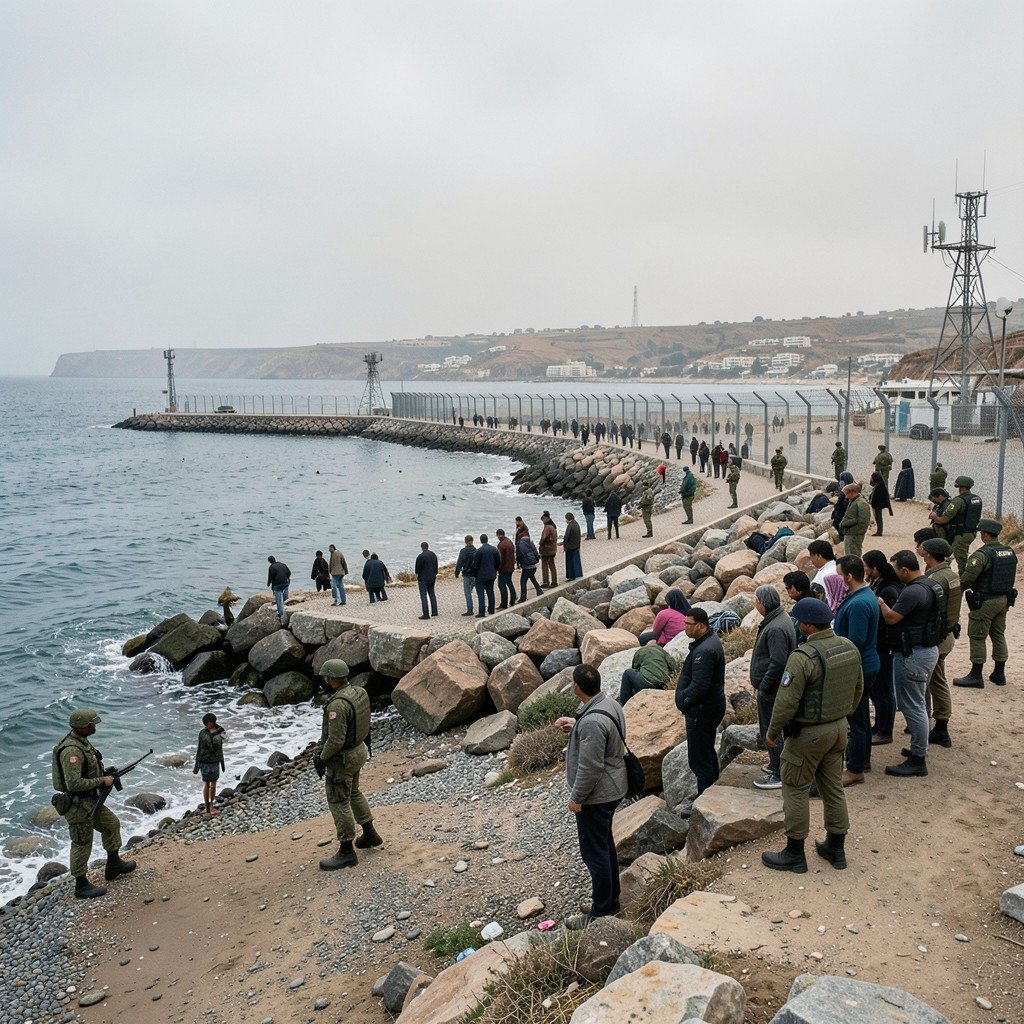
AI-generated representative image: Spanish military and police deployed along Ceuta's coastal border following a deadly migrant surge from Morocco.
Editorial Team
Editorial Team
Sanchez visits enclave as 60,000 cross from Morocco, triggering Schengen suspension calls across Europe

Spain has deployed military forces and additional police to its North African enclave of Ceuta after at least 34 people died attempting to cross from Morocco by land and sea, according to the enclave's president. The deaths occurred as thousands of migrants surged into the Spanish territory on Thursday and overnight into Friday.

Prime Minister Pedro Sanchez visited Ceuta on Friday, confirming that approximately 60,000 people had entered the enclave in recent days - a figure exceeding half of Ceuta's total population.

The sudden influx has triggered a political crisis across Europe, with France tightening border controls with Spain, Italy threatening extraordinary measures, and senior politicians calling for Spain's suspension from the Schengen free-travel area. The episode places intense pressure on Sanchez ahead of next year's elections and raises urgent questions about the EU's capacity to manage irregular migration at its only land borders with Africa.

How the Crisis Unfolded

Migrants crossed into Ceuta by sea and over land beginning Thursday, with arrivals continuing into Friday despite reinforced security. Spanish authorities dispatched military personnel while Morocco deployed security forces and water cannon to push back crowds at the border. Reuters footage showed large groups - predominantly young Moroccan men but also families with women and children - moving around breakwaters and onto roads inside the enclave.

Clashes between security forces and crowds left a burned bus and seven cars destroyed near the border. Although the main border crossing appeared blocked, groups continued moving along the coastline searching for alternative routes, with some preparing to swim around barriers. Footage filmed after 11:30am local time on Friday showed migrants still entering through the Tarajal beach area.

Among the 34 fatalities, many drowned during the sea crossing while others died in a crush at the breakwater fence near Tarajal beach, authorities said.
Ceuta's Strategic Significance

Ceuta is an autonomous Spanish city on the north coast of Africa bordering Morocco. Along with Melilla, it represents one of only two land borders between the European Union and Africa. The territory came under Portuguese rule in 1415, passed to Spain in 1580, and remained under Spanish sovereignty after Portugal regained independence in 1640.

The enclave is protected by high border fences, surveillance systems, and a permanent deployment of Spain's Civil Guard and National Police. Migrants typically attempt to reach Ceuta by swimming from the Moroccan town of Fnideq - a journey of about 5 kilometers - or from nearby Belyounech, where the distance is shorter.

Ceuta authorities have linked the latest surge to a Spanish Supreme Court ruling this month that barred authorities from immediately returning migrants intercepted after arriving by sea without due process. The ruling does not apply to those entering by land, including individuals climbing the border fence. However, some migrant rights activists in Morocco questioned this explanation, noting that most migrants would have been unaware of the court decision.

Official Statements and Political Reactions

Sanchez described the situation as "unexpected," noting that Spain had recorded a roughly 40 percent reduction in illegal immigration last year. "What happened yesterday breaks with a pattern we had seen consistently," he said, pledging to defend Ceuta "as if it were Madrid." He confirmed that Moroccan authorities are willing to cooperate on repatriations and suggested legal changes might be needed to guarantee efficient returns at the border.

European Commission President Ursula von der Leyen called the images from Ceuta "unacceptable," demanding that dangerous crossings stop immediately and that smuggling networks be dismantled. France's Interior Minister Laurent Nunez activated rapid intervention border units for more intensive inspections at the Spanish border. In Italy, Prime Minister Giorgia Meloni said her government was prepared to intervene with "extraordinary measures," while Deputy Prime Minister Antonio Tajani called for closing the Schengen Area to Spain.

Former EU foreign policy chief Josep Borrell, however, stated that no member state can unilaterally suspend another's participation in Schengen under EU law, calling the episode "quite revealing of how EU governments are learning to understand, talk, use and abuse the EU's legal order."

What Happens Next

Sanchez has indicated that repatriations to Morocco will begin "as soon as possible," with Moroccan authorities cooperating on the process. The Spanish government is considering legislative changes to facilitate faster border returns following the Supreme Court ruling. Meanwhile, opposition parties continue to pressure Sanchez's government, with Ceuta's mayor calling for a state of emergency and the People's Party leader describing the situation as a "national security crisis." The crisis is expected to dominate political debate in Spain as next year's elections approach.

MORE LIKE THIS

Comments (0)

Leave a comment

A verified Gmail account is required to post comments.

No comments yet. Be the first to share your thoughts!