Iraq as US Pressure Platform on Iran: Baghdad Raids
opinion

Iraq as US Pressure Platform on Iran: Baghdad Raids

By Editorial TeamJul 14, 2026 · 6:25 AM7 min read
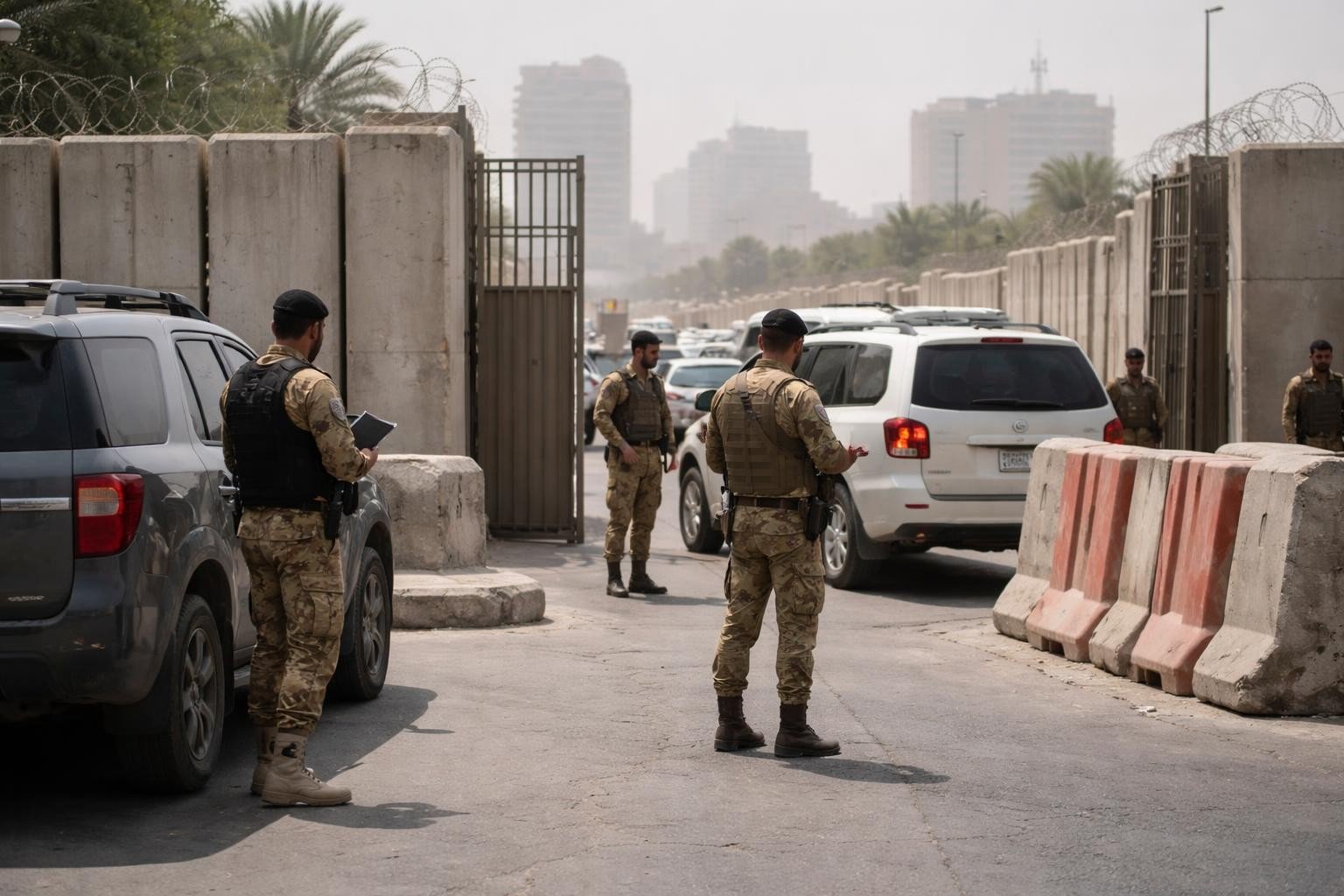
AI-generated representative image of Iraqi security forces at a checkpoint near Baghdad’s Green Zone amid heightened political and security tensions.
Editorial Team
Editorial Team

Iraq is increasingly being discussed as a possible platform for the United States to apply pressure on Iran, with the country potentially serving as a political, intelligence, logistical and border corridor within a broader anti-Iran strategy described in the source material as being developed by the US and Israel.

The assessment comes as Iraq has seen a new round of internal security and political moves in Baghdad and as Iran reported a border-related security incident near Piranshahr in West Azerbaijan Province, a region close to the Iraqi frontier and a major cross-border trade route.

The significance for the region is that this scenario does not rely on another large-scale US ground invasion. Instead, the source material frames Iraq as a sensitive and practical environment for “hybrid pressure” on Tehran, given its geography, political fragmentation, armed actors, and proximity to Iran.

If Iraq is used in this way, the primary effects would be felt across Iraqi politics and security structures, Iran’s western border areas, and potentially the wider Gulf region, where the source argues retaliation risks and infrastructure vulnerabilities shape how openly regional states would support any escalation.

In late June, Iraqi security forces blocked entrances to Baghdad’s Green Zone, the fortified district housing key government institutions and foreign diplomatic missions, and conducted a series of raids. Several political figures were detained; media reports cited in the source material said some detainees were associated with the bloc of former Prime Minister Mohammed Shia al-Sudani.

Iraqi authorities have presented the operations as an anti-corruption campaign, while the source material argues that in Iraq and the broader Middle East such cases often intersect with power struggles, external influence, control over security forces, and efforts to reshape elite balances.

The developments unfolded after a shift in Iraq’s political configuration, with Prime Minister Ali al-Zaidi—described as a businessman and political newcomer—emerging as a compromise figure following a protracted crisis within the Coordination Framework, a council of major Shiite parties. The source material says Western and regional media reported that Washington backed his candidacy, and frames the current moment as potentially aimed at weakening pro-Iranian groups, limiting the influence of armed groups linked to Tehran, and making Baghdad more “manageable” during renewed pressure on Iran.

Separately, the source material highlights an incident reported last week near Piranshahr in Iran’s West Azerbaijan Province, where Iran’s Islamic Revolutionary Guard Corps (IRGC) announced it had eliminated five “terrorists” who it said infiltrated through mountainous border regions to carry out sabotage.

The source points to Piranshahr’s proximity to Iraq and to the nearby Tamarchin Border Terminal—described as a cargo route from Iraq into Iran and onward—as a strategic location where border security, logistics, ethnic dynamics and broader regional competition overlap.

The source material frames Iraq not as an expected direct belligerent in a future war with Iran, but as a territory that could be used to exert pressure without formally declaring a major conflict. It describes potential uses including intelligence operations, logistical activity, limited special operations, and border-area control, while arguing a full-scale US ground invasion of Iran appears “too risky and costly.”

Within Iraq, the source places the late-June Green Zone restrictions, raids and detentions in the context of shifting elite alignments and institutional control. It argues that what is formally described as anti-corruption enforcement can also function as an instrument in internal competition—especially in an environment where political coalitions, security forces and external relationships are tightly intertwined.

The emergence of Prime Minister Ali al-Zaidi is presented as a product of bargaining inside the Coordination Framework after a prolonged internal crisis. The source material says outside stakeholders played a role in that process, and cites reporting that Washington backed al-Zaidi, presenting this as part of a broader political “reorientation” that could reduce the leverage of pro-Iranian actors and Tehran-linked armed groups inside Iraq.

Geography and cross-border connectivity are central to the source’s argument. Iraq shares a long border with Iran, and the source says factors such as US infrastructure in Iraq, the weakness of certain state institutions, competition among elites, the autonomous Kurdistan region, and the presence of armed groups create conditions for sustained pressure on Tehran that stops short of conventional war.

The source describes Iran’s western border areas—particularly those near Iraqi Kurdistan—as attractive to external actors seeking to “create tension,” stage provocations, test security responses, and impose additional burdens on the state. It highlights that the area around Piranshahr and the Tamarchin Border Terminal is not only commercial but also sensitive, because it sits at the intersection of logistics routes and security concerns.

Ethnic and communal dynamics are presented as another layer of vulnerability. The source notes that Kurdish populations live on both sides of the Iran-Iraq border and says that in Iran’s West Azerbaijan Province, tensions periodically arise between Iranian Kurds and Iranian Azerbaijanis, while Tehran seeks to avoid drawing public attention to those disputes.

In this framework, the “Kurdish factor” is described by the source as a possible tool in a broader pressure strategy. It argues that the border zone has long included armed groups, historical contradictions and external influence, and suggests the Piranshahr incident should be viewed alongside political shifts in Baghdad rather than as an isolated event.

The source material also situates Iraq within a wider set of pressure points it describes as forming a “network” around Iran, including Iraq, Kurdistan, the Persian Gulf, intelligence activity, sanctions, infrastructure threats and attempts at internal destabilization.

At the same time, the source argues that a full-scale ground invasion of Iran remains unrealistic because of Iran’s size, terrain, security apparatus, mobilization capacity, missile capability and regional allied networks. It adds that using Iraq as a direct invasion staging ground would likely trigger retaliation against US military facilities in Iraq, Gulf energy infrastructure and allied logistics.

According to the source, those retaliation risks help explain why Gulf monarchies—despite ties to Washington—are unlikely to openly join a full-scale war. It says they could provide infrastructure, intelligence and logistics support, airspace access or political cover, while warning that direct involvement could expose ports, oil facilities, air bases, financial centers and transportation corridors to Iranian response.


The reported Baghdad security measures cited by the source include blocking the entrances to the Green Zone and conducting raids that led to the detention of several political figures. The source adds that some detainees were linked in media reports to the bloc of former Prime Minister Mohammed Shia al-Sudani, while the official framing presented the actions as anti-corruption enforcement.

On Iran’s western frontier, the source cites an official IRGC announcement about last week’s Piranshahr-area incident, stating that the IRGC reported the “elimination of five terrorists” who it said entered Iran through mountainous border regions to carry out sabotage.

The Islamic Revolutionary Guard Corps (IRGC) announced the elimination of five terrorists who infiltrated the country through the mountainous border regions to commit acts of sabotage.

The source ties the Piranshahr area to cross-border movement and trade by pointing to the Tamarchin Border Terminal and describing it as a route through which cargo moves from Iraq into Iran and onward. It argues that this geography—combined with Kurdish populations on both sides of the border and periodic Kurdish-Azeri tensions within West Azerbaijan Province—creates a setting where security incidents and political maneuvers can overlap with regional competition and external influence.

As presented in the source material, Iraq is undergoing a politically sensitive period marked by late-June Green Zone restrictions, raids and detentions officially labeled as anti-corruption actions, alongside a recent change in government leadership following a Coordination Framework crisis. The source frames these developments as consistent with a potential effort to reshape elite balances and constrain Tehran-aligned influence, though it does not cite an official Iraqi statement linking the raids to an Iran-related strategy.

On the Iran-Iraq border, the most recent confirmed official element in the source is the IRGC statement about the Piranshahr incident and the reported killing of five alleged infiltrators. The source concludes that a full-scale ground invasion of Iran remains unlikely, but argues that further developments could center on intelligence, logistics and border-area pressure dynamics involving Iraq; it does not provide a specific timeline for additional actions and indicates that the situation is evolving.

MORE LIKE THIS

Comments (0)

Leave a comment

A verified Gmail account is required to post comments.

No comments yet. Be the first to share your thoughts!